
Platform · Threat Hunting
By the time you read the threat report, the hunt has already run.
Agentic attacks are not predictable, and the ones that matter most are the ones nobody has written a rule for yet. Hunting is where Artemis continuously goes after the unknown unknowns reacting to the news within minutes, and researching your own hypotheses around the clock.
Who this is for
Incident response and detection engineering teams who buy threat intelligence they do not have time to operationalize or seek deeper detection coverage.
New threat intelligence at machine speed
A campaign is published. Artemis reads the report, maps it to your telemetry, hunts retroactively for TTPs and IOCs, and tells you whether you were affected while your team is still reading the summary. Public exploit to detection in minutes.
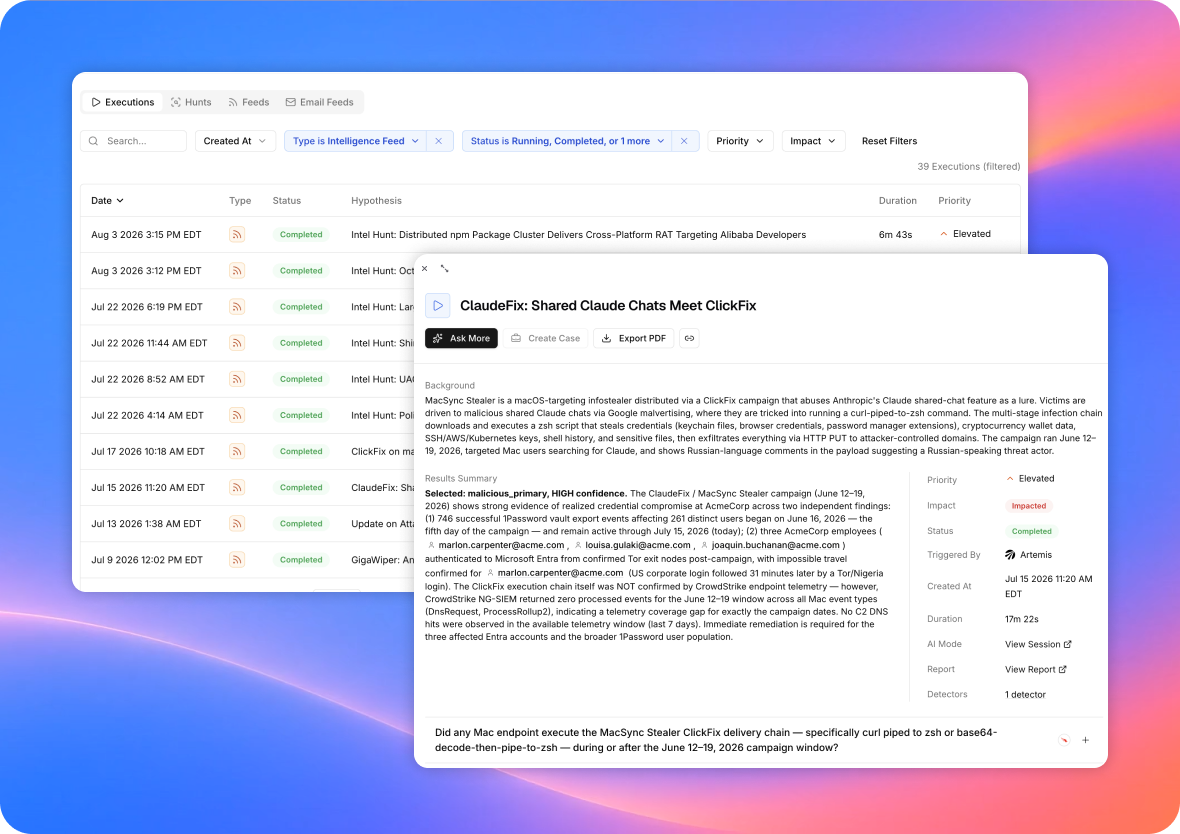
Hunting TTPs and IOCs across your security data
Continuous hunts run daily against a growing library and the 100+ intelligence feeds behind it, across every connected source. Ad-hoc hunts run from a question in natural language: are there any indications of human usage of service accounts in the last 30 days?
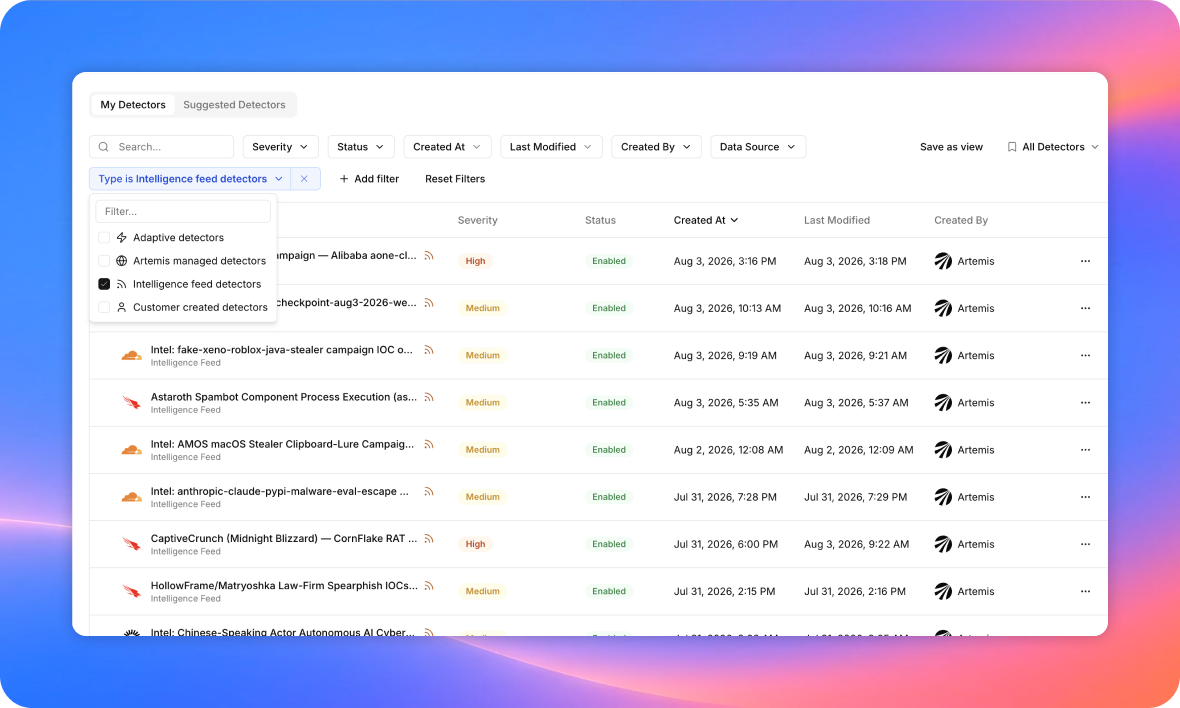
Detections generated from what the hunt finds
A hunt that finds something does not end at interesting. However, it doesn’t mean you won’t be affected in the future. Artemis turns potential exposures into detectors for your environment, so the same activity is caught automatically if it occurs. Findings link forward into the insights and cases they produce, and every hunt ends in a board-shareable report.

Everyone buys intelligence feeds. Turning a published report into working coverage takes two weeks by hand. Artemis closes it in minutes.
Frequently asked questions
Not in a specific query language. Hunts are described in natural language and Artemis runs them across every data source, showing the work.
Hot data is sub-second for 60 days, and the cold tier stays queryable in the same schema for up to seven years.
Yes, as a standalone package as well as part of the platform.